

Insult, whether that be to you or me. Is that worthy of deliberation by onlookers or a jury; or individual classification?
Life isn’t an exact science. We’re ever changing creatures built with our own uniquely designed senses, as we’re not an inanimate object which you can duplicate to your heart’s content. Cars are designed with replaceable parts, human beings aren’t so replaceable or mechanical. We adapt, learn and somewhat even change to fit one’s or life’s script. Our blueprint is unlike any other. So when do we draw the line to say, enough is enough? Or is that dependent on when society approves or corroborates our perception?
I’ve learnt, if you always wait for others’ approval, you repeatedly second guess yourself. Almost not deeming your own mind or experience unsubstantiated unless affirmed by another being. Why have we given automatically invalidated our own sense of self?

A lack of confidence, uncertainty or guilt can be some of the reasons why we may seek a second party’s perspective, which is natural. But one thing I regard differently, is someone telling you how you should think or feel. That my dear, is something called control and possibly manipulation. The one thing you can control, is your own life. Don’t let back seat drivers think they can encourage your past or future manoeuvres. If your auto-pilot function is living for others or their observation is paramount compared to yours, change that. You’re even disrespecting yourself by allowing yourself to be an afterthought.
Trust the process. Trust yourself. Your perspective is key, be your own cheerleader. Don’t rely on others for affirmation, the relay of info, experiences and emotions will never compare to witnessing your live-action life, one frame at a time.
If you feel disrespected, more often than not, you probably have been. Second guessing can enable more of this behaviour due to hesitancy. After all, who knows you better than you know yourself?
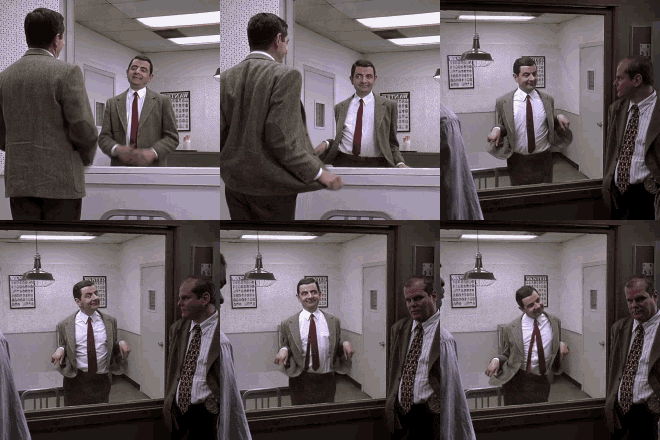
What do you think? How do you react to disrespect? What was your experience like? Comment below!


Well written post🌹🌹
LikeLiked by 1 person
Thankyouu so much and glad to hear you enjoyed reading this post, Satyam!😊🤍
LikeLike
I feel that disrespect is something perceived by the individual: something I may find offensive would be no issue for someone else, and vice versa. It’s why I have problems with online outrage: all too often the person who’s been “slighted” is actually fine and has no problem with anything that’s been said.
The arbiters of internet morality, meanwhile, are losing their s***, getting outraged “on behalf of the insulted person”, and pillorying the perceived offender.
I think the baying crowd needs to cool their jets until the “victim” actually states that they are, in fact, a victim in need of assistance.
(But I also concede that the actual answer is, “it depends”, and that this is not a one size fits all solution… Just before anyone gets upset 😉)
LikeLiked by 1 person
Yes, I completely get that point! I think on the internet, far too many act like a cult or clique reiterating the same opinion, if anyone opposes that or shares an independent opinion that may not align with the rest and you’re almost crucified for not following every Tom, Dick and Harry.
One of the downsides when it comes to the internet, more specifically social media.
Of course, people and their opinions are much more complex then simply labelling them either victim or culprit and everything else in between.
It’s simply ignorance and enables brainwashing, due to the ease of being able to shun someone.
Thankyouu so much for sharing your insight!😊🤍
LikeLiked by 1 person
I can totally relate to this. I hesitate to say even when I know that the other person has insulted me in a subtle way, but I am trying to be assertive now.
LikeLiked by 1 person
Me too, I later realised I only hesitate due to the possibility of being rejected or being seen as the problem for standing up for myself. Resuming a passive facade by not voicing your boundaries only leaves you feeling smaller than the person who minimised and disregarded your internal description of what respect means to you.
Thankyouu so much for sharing your insight, Payal!!😊🤍
LikeLiked by 1 person
How do you react to disrespect? I don’t simple as that – we all have out own respect, reacting or over reacting is a waste of energy, spilt milk, so move on. Mostly it is the other person that has the problem, not me.
LikeLiked by 1 person
It most commonly represents another party’s inadequacy and not yours, precisely. With that being said, they’d prefer to attract you into their Venus flytrap which feeds off disrespect. Rise above disrespect, as it may try to knock you down possibly when you least expect.
Thankyou so much for sharing, Walter!😊🤍
LikeLike
Another thought-provoking post.
Dealing with disrespect can be really challenging. I believe it’s important to set boundaries and communicate when I feel disrespected. I also think it’s crucial to reflect on the situation to understand if there’s a pattern and to decide on the best course of action (no harm intended, no harm taken).
LikeLiked by 1 person
Aw thankyouu! Yes, boundaries are necessary for outlining what you will and will not tolerate, enforcing limitation in regard to what is and isn’t okay with you. It’s far easier in the long run, referring to a default guideline to judge whether your interpretation is valid, or potentially biased. People have a tendency to blur the lines with certain people due to the specific relationship they have, but that has the danger of enabling habitual disrespect you could fall victim to, which often may go unnoticed, by yourself and/or others.
Thankyouu so much for sharing your words of wisdom, Tom! Hope you’re having a nice, relaxing Sunday!😊🤍
LikeLiked by 1 person
Hey Antonia, you’re totally right about blurring the lines with certain people – mea culpa. Thanks for the insight!
LikeLiked by 1 person
You’re so welcome!😊🤍
LikeLike
“Another insightful post. Handling disrespect can be quite challenging and emotionally draining.”
LikeLike